Showing posts with label wildlife conservation. Show all posts

Saturday, May 5, 2018

E.T. settles in

Two years ago, after I made the somewhat unsettling decision to move to Sri Lanka, I felt like I was an alien that had unknowingly arrived at the correct planet. Many years prior to that, I felt that my interests in wildlife conservation were a little strange and highly idealised, even. Having spent a good part of my early life stuck in the obsession of being a veterinarian and eventually having to concede that it was not practically possible, I thought it was too late in life to ever find satisfaction in a closely related job and that I'd die with regrets. It was my stint at the Singapore Zoo that gave me a renewed sense of hope. I still work with more people (i.e. lesser animals) than I would like to, but I feel strangely at home in these circumstances I have fallen into. For the first time, I've found many more people like me (or better even), so much so that I am no longer an outlier in contrast. For once, I feel that talking about saving animals and having those conversations at work is not something that would raise eyebrows or sound silly enough for others to make jokes about it.

Yesterday at work, we completed a 2-day workshop for 18 NGOs (consisting of about 60 individuals) who will be working with the UNDP GEF Small Grants Programme for the next two years. Sure, there were small hiccups here and there, but our efforts in organising the event mostly paid off. Even though I was on the event management side of things, I learnt quite a lot of things on formulating projects according to the Logical Framework Approach (LFA) method, applications of Geographic Information System (GIS) tools in projects and the importance of using good communications.

On Day 1 of the workshop, I was put on the spot with a request to be the compère. Despite the great lengths I go to avoid standing behind a podium, I get cornered sometimes. And being an adult and realising I was one, I had to play it cool. First, I was given the simple task to welcome the participants, do a quick run through of the agenda and introduce the first speaker. Being me, I messed up, of course. I accidentally introduced the second speaker first. After that blunder, I fared better. Thankfully, I realise that with age, I am getting more humiliation-proof. Those small things that used to embarrass me and make me very anxious are becoming fewer in number. Even the really embarrassing things that happen, I realise, are but a moment that will be soon forgotten, or would end up a good lesson or become fodder for a good laugh in future. And these are all equally good outcomes.

On the morning of Day 2, just as I woke up, in a state of semi-sleep, I mentally drafted the best opening lines for the workshop. I come up with the best imaginary speeches at that time of the day and some of those speeches really blow me away. As usual, I remembered none of that when I stood behind the microphone. The segments where I had to use the microphone for bossing people around to remind them to hurry up, submit forms, etc, were easy. Someone I knew from my childhood once pointed out (to my surprise at the time, I admit), that I am bossy. This small talent of mine for pushing people around, especially if they are lazy, incompetent, uncooperative or ridiculous and reverses the "forward-flowing" energy of life can be good sometimes. It's no wonder that I took a liking to the quality assurance and regulatory compliance (i.e. policing) aspects of my previous profession, which involved setting things "right" (to accepted standards), despite the unpopularity. This is making so much sense now. But Shuri, you are lazy too!! Shhh, this isn't about me. 

The workshop left a profound impression on me. The participants were people from different walks of life who bid and won grants (through a tough selection process) for environment-based projects involving communities to improve things in Sri Lanka. To see the vision and ideas of how different people proposed to do things, including the introduction of innovative solutions, were very interesting. They spoke with passion. Sure, these were only at a conceptual level for now, sounding great on paper, and implementation on the ground would be a challenge. Still, it was nice to play with the thought that if done right and all these projects achieve a high success rate, it would be a great accomplishment. Given the little experience I have gained from this job, I know that there will be plenty of obstacles, for example, failures, mismanagement of funds, disputes, unforeseen circumstances, show-stoppers or even grantees losing interest, after the project kicks off.

The projects to be implemented touched on various areas like eco-tourism, agriculture, community livelihood development, increasing biodiversity and environment conservation. I have already taken a special liking to a few projects that focus more on wildlife.

One of the participants was a young lady (possibly under 30 years of age) who's made herself a name in the wildlife conservation circles here for being a passionate and driven individual. She's made it her life's mission to protect the Fishing Cat population living in the highly urbanised city of Sri Lanka's capital, Colombo. During the applications process, she wooed the panel with her charisma and youthful optimism in wanting to fight the odds to carry out her mission. Fishing Cats are nocturnal, so many city-dwelling people don't know about their existence or the decline of populations, unless they become roadkill or are caught and killed by people for attacking poultry. In her project, she's used the Fishing Cat as an indicator species to assess the health of Colombo's urban (inland) wetlands, which are its natural habitat range. This is a project I am looking forward to since it is going to involve the building of an animal rescue and rehabilitation center (* gets distracted thinking of Fishing Cat kittens * SHURI, focus on finishing this post with a serious tone!)


The Fishing Cat is found in various parts of Asia, including Sri Lanka (Image Source: http://www.fishingcatcambodia.org)


One project is going to increase nesting areas and habitats for the wildlife in urban Colombo, such as for the endangered Purple-face Leaf Langur, insectivorous bats, wetland birds and the Fishing Cat. With an increasing human population in the cities, animals are rapidly losing their homes. While we can't do anything about an increasing human population, there's hope in trying to help humans and wildlife co-exist. The project will also carry out various activities to remove invasive plants that are wiping out indigenous species of plants and slowly destroying the balance of wetland ecosystems. The person leading this project is also a passionate zoologist who volunteers his weekends to educate members of the Young Zoologists Association. He has experience in working with the National zoo and he led a project which was instrumental in establishing the only official wildlife rescue and rehabilitation centre in Colombo through a previous grant.

Another noteworthy project will be implemented by a university in the north of Sri Lanka. The project is led by a young gentleman (also under 30 years) who is a passionate zoologist and a probationary lecturer. He also wooed the panel with his subject knowledge, humility and his determination to improve the lives of the people in the area who were for decades affected by Sri Lanka's 30-year old civil war. Their project will involve the establishment of an outdoor laboratory for university students in the midst of a coastal wetland and will include boardwalks, etc. The site will also be promoted as an eco-tourism destination for activities like guided nature tours, boating and bird-watching for generation of income to the impoverished and isolated communities living in the area.

Another one of the projects is led by a leading herpetologist/ photographer. In November last year, he was part of a team that discovered the newest species of snake in Sri Lanka. In addition to that, his research findings have led to discoveries of over 20 (and counting) other new species which include snakes, amphibians, geckos and skinks in Sri Lanka. He didn't have a pompous air about him, despite his impressive career background. With my liking for reptiles, it was hard not to want to strike reptile-related conversations with him (nothing even remotely intelligent-sounding came to my mind, to be honest) or make him talk about his subject to satisfy my inner fan. I just stuck to small verbal exchanges relating to the workshop. I am happy and shameless to say I was able to manipulate the course of events and get a (group) photo with him in it. Seriously, Shuri!

It takes the coordinated effort of many individuals in various capacities to make a project a success. The grant that we (the organisation I work for) received was to oversee the knowledge management and capacity building aspect of several of these individual community projects located in the Colombo urban wetlands landscape. We are one of the mid-way links between the ground level and the funding agency. It will be our job to monitor progress, to facilitate project activities, to intervene when things are not going well, to link the ground level project persons with higher level authorities, to help communities to link their enterprises to larger market chains and finally, to use communication tools to showcase and document what the projects are up to and have ultimately achieved. Because ultimately, grant-based development work is part of a cycle where good work (as showcased by good publicity) will attract more sponsors and grants, which will in turn bring more opportunities to people and community level organisations to carry out good development work (mostly for the environment, in our case). That's the theory, at least.

On the downside, working with NGOs entails some effort to be optimistic and trust that people will maintain their good intentions and not become too corrupt in the face of extra money, and if they do, to be as vigilant as possible to close any loopholes that would allow it, without letting emotions run you over and make you form a too negative outlook in life. On the upside, there are several capable and driven people working in these projects, including young people who give the conservation field much hope, and there will certainly be a few successful projects that will leave a lasting impact. I don't know where life would take me in the next two years, but the end results of this phase of projects are something I'd really like to see.

Thursday, August 25, 2016

Back to School

Returning to school after nine years comes with a fair share of challenges. You find that your brain isn't as sharp as it used to be in high school. Then you realise you have become an expert procrastinator, which isn't a good thing when pursuing a postgraduate level course. You also realise your hands don't cooperate anymore when writing down notes at a fast pace and your handwriting is now worse than a third grader's.

In addition to the above, I've also jumped into a science course after nearly a decade of not working in a related field (okay, maybe volunteering occasionally at the zoo counted for a little). The consequence of this is that I found myself in a class of mostly younger people who are more qualified, focused and academically sharper.

I've had to adapt to some new behaviours too. No one eats with cutlery here unless they have some kind of hand injury. Some restaurants look unhygienic and makes stomachs cringe. Students here also are used to eating together and sharing lunches. This is an effective arrangement to minimise food wastage and save money. It was a little awkward at first and years of being psychologically put down as a left-hander made me wonder if my lunch mates feel uncomfortable sharing food with me. But my two lunchmates seem to take no notice and they even voluntarily eat vegetarian food with me just so one half of a packed lunch does not go to waste.

On a related note and coming from Singapore where good hygiene is overly emphasized to reduce the spread of diseases, I find it appalling that a vast majority of public toilets in Sri Lanka do not have soap to wash hands. Even my institute that calls itself a leader in postgraduate Science education does not provide soap in the student toilets. I once voluntarily left a piece of soap for public use. Now it's over and needs replacing. I guess I'm going to be the unsung toilet hero that helped reduce the spread of gastrointestinal and respiratory infections in female students till the end of 2017. I now also carry a small bottle of hand wash wherever I travel.

Singing on class (field) trips in my native language is also something I am not used to. I have not actively paid attention to pop culture in my country for about twelve years so I've missed a lot. I also grew up in a multicultural setting in all educational institutions I've been to so it was hard to find songs for which everyone knew the lyrics to. And even for the English ones which everyone knew (mostly from singing class), we had no capable musical conductors to take the lead or musicians who could play a guitar or the conga drums. Anyhow, for this trip, I had to settle to mostly clapping and joining only when classics and songs older than twelve years were sung. I must admit, these students are very experienced at musical entertainment and even carry tiny song books with them!


"Conga" drums are a must-have on all long distance group trips in Sri Lanka. 
(Image source: Tremuloumusic)


After a couple of months here, I've started to fit in, find ways to promote harmony and feel humbled observing those around me. In most ways, I have an easy life. I live closer to the university than most (about 15 km away). I don't have a full time job or dependents to tend to, which is highly advantageous when pursuing studies. Though lacking in core subject knowledge and work experience, my English standard is above the class average which also helps. There are students who work full time jobs and travel hundreds of kilometers from various corners of the country, enduring a lot of hardships every weekend just to come for lectures. Some stay alone in hostels for the weekend and not see their families for many months on end. Some, I also learnt, do serious hands-on work in their respective environmental fields and are working hard with the goal to move onto better opportunities outside this country.

Lack of privilege is a cruel thing. If some of these driven, hardworking and capable students had the same privileges and opportunities I was fortunate enough to have while growing up, I'm sure they would have put it to better use and be in much better places by now.

According to an interesting interactive tool from the BBC called "How equal are you?", Sri Lanka ranks 84 in terms of gender equality.


 That's a positive sign too. Although, the same tool also states that only 39% of women are currently in a job or looking for work. This could imply that a vast proportion of female university graduates eventually take up stay-at-home roles (temporarily or otherwise).


In our class of 24 students, the female to male ratio is about 50:50. About 30% make up minority ethnicities. In a country that was war-torn for two and a half decades and where racial tensions with other minorities still bubble beneath the surface, one's race is a sensitive issue. When I first joined the course, I could feel the walls that the students erected around themselves and their comfort groups. There was hardly any mixing around.

Two months later, as we get to know each other better, core personalities are becoming apparent. Some are clearly leaders who like to take charge. They like to be the voice of the class and take the trouble to gather everyone on social media or worry about refreshments for everyone on class trips. Some are the suspicious and distant types who are not yet ready to be vulnerable with others. Some are the responsible types who assist the leaders and are given jobs that require accountability like being class monitors or photocopying precious notes for the whole class. Some are the leech-y types who like to take shortcuts and form alliances to receive advantages. Some are the helpful types who help other students with information, lecture notes or teach them how to do complex calculations. Some are comedians who maintain an air of lightness and joy. Some are good musicians who entertain everyone during class trips. Some are like neutrons. They keep a good balance by doing nothing good or nothing bad (this also helps reduce too much negativity).

Then there's me. I see myself as a neutral party that closely observes this fascinating ecosystem and occasionally anticipates and springs to action if someone needs help or something needs to be done to bridge gaps or maintain harmony.

It won't be long before we are more united as a class. After two field trips and some group projects, the walls between different races are very slowly coming down, trust is building up and people are connecting on a human level. Like for example, we were in groups of six in each safari vehicle during our last trip to Kaudulla National Park. At first, they laughed at me for putting on sunscreen lotion. Then they changed their minds and borrowed my lotion. Later the idiots thanked me for helping them minimise exposure to harmful UV radiation. Soon after, everyone was asking each other's life histories, work places, ages, showing photos of their partners, joking about being bald, exchanging phone numbers to keep in touch, congratulating some who just became new parents or newly engaged, etc.


Most of these migratory elephant herds spotted at Minneriya National Park last month have moved through the Elephant Corridor at Kaudulla-Minneriya to Kaudulla National Park. 


We went on a field trip to Kaudulla National Park see elephants, other mammals and loads of birds. Thanks to the sharp eyes of our lecturer and the collective group, we spotted a Ruddy mongoose, Golden jackals, Toque macaques, Grey langurs and the Sri Lankan axis deer for mammals (that's 6 out of a reported 24 mammals in this park). The lecturer is a huge fan of birds so he was clearly biased towards them and had to help us out in identifying nearly 35 species of birds (out of a reported 160 species of birds). Honestly, some types of birds looked the same to me so I have a lot to catching up to do to become familiar with identifying birds. And just to make my day complete with reptiles, we spotted a Water monitor lizard, Common garden lizard and a freshwater testudine that looked like an Indian black turtle (that's 3 out of 25 reported reptiles).

Overall, it was a fun trip and perhaps a sign of good things to come.

Saturday, July 26, 2014

An Autobiography: Approaching Full Circle


"What A Wonderful World" - A powerful 2 minute video that sums up what it is that we are going to lose if we don't change or get involved 

If we were to compare the Earth's habitable environment to a good family inheritance, we are not only spending it away faster than all the time it took our ancestors to save up, we are also borrowing credit from what might have been the inheritance of our descendants. As world's population increases and moves towards development, we have exceeded the Earth's natural capacity to supply in relation to the existing demand. Of course, we don't contemplate on this on a regular basis so the normal tendency is to passively navigate ourselves around the tell tale signs (and the not-so-obvious ones) towards comfortable and profitable goals that often provide instant gratification.

I'm guilty of it too.

Looking back from where I am now, my yearning to get involved in the conservation field has, somewhat ironically, taken me to United Arab Emirates and Singapore. These two countries topped the globe in terms of their ecological footprints (UAE at No. 3 and Singapore at No. 12) according to the WWF Living Planet Report of 2012. Not only that, I am currently an employee of the Oil and Gas industry which is largely responsible for the depletion of the Earth's natural oil and gas reserves and indirectly responsible for increased Green House Gas emissions in recent history. This is just one example of how our sophisticated lifestyles – just as they are interconnected with the Earth's biological ecosystems – are also dependent on activities setting the planet on an irreversible course of destruction. The way I see it, we are all (to varying degrees) part of the problem and part of the solution to this environmental crisis.

Sri Lanka is a country with abundant natural resources having one of the highest biodiversity densities of Asia and I called it home for the first 18 years of my life. As a child, I loved spending my time outdoors, doing regular rounds of “garden patrol”, observing various plants and animals that were a common sight and spending time by a river that flows beside my house. One of my greatest joys was rescuing injured, sick or abandoned animals and nursing them back to health. It was a role I took up very seriously and for which I had the full support of my parents. 

I was also fortunate to spend various phases of my childhood with my two grandfathers, from whom I have learned much about using resources in a "sustainable manner" - a term I didn't come across until many years later. My maternal grandfather was an advocate of “reduce, reuse and re-cycle” policy where he carefully made the best use of all paper, plastic, metal, glass and wood until they had no more uses. My paternal grandfather supported the livelihood of local farmers and he himself was a passionate planter who selflessly left behind the fruits of his agricultural labour for the benefit of his future generations. With those early influences, among others, caring for the environment that sustains us may be associated to me with a sense of obligation rather than being just a passion. 

Since arriving in Singapore in 2004 to do my undergraduate studies, I've had all my basic necessities and creature comforts. However, growing up was a slightly different affair in Sri Lanka. We had to live in a sparing manner since most basic resources such as water and electricity were limited and we were constantly affected by power outages and periods of drought. My village didn't have the infrastructure to tap into the national water supply, but we were fortunate enough to have naturally occurring wells and a river nearby for basic needs for water. 

Dubai was my home for a brief 2.5 years while I completed an overseas work assignment from 2010 onwards. The United Arab Emirates is a rapidly developing country and Dubai is a melting pot of foreigners from all over the globe. The new environment, new challenges, new acquaintances and my new-found sense of independence suited me well. My boss who was a co-owner of the company took an interest in my potential and supported me in becoming a certified ISO 9001:2008 Quality Management Systems Internal Auditor to audit company policies and procedures, although it was not my main scope of work. After trying out various responsibilities within the company, I realised that my personal strengths and continued interest in relation to a career would lie in work that required careful observation, attention to detail and doing lots of writing.

It is easy to assume that a rich desert city such as Dubai which is heavily dependent on the abundant natural oil and gas resources in the region to maintain its luxurious artificial splendor would have zero interest in conservation. However, even there I found active conservation groups such as EWS-WWF and the Emirates Marine Environmental Group (EMEG) which organises environmental awareness and conservation activities (most notably their turtle rehabilitation and release programs). On a hopeful note, both these groups had a substantial number of passionate volunteers, young and old, supporting their causes. Within the UAE, I also managed to travel to places such as Fujairah (one of the seven “emirates” or states making up UAE) which had better weather compared to Dubai and coral reefs to be explored. Also within driving distance was Musandam (Oman) which was a popular location for dolphin watching. One interesting place that I could not visit in my time there was Bu Tinah Island - an official finalist for the “New7Wonders of Nature” competition in 2011.

The next phase of my life brought me back to Singapore in 2012 where I am currently employed as an ISO Quality Auditor. My work revolves around quality assurance for fabrication of FPSO (Floating, Production, Storage and Offloading) units and assisting with statutory/ regulatory compliance for these units sailing to offshore oil fields such as Brazil, Angola and the Gulf of Mexico. From an environmental perspective, my work contributes to ensuring that vessels leaving the port comply with the standards of the International Maritime Organisation (IMO) – most notably the MARPOL (Marine Environment Protection Committee of the IMO) Standards - to minimise marine pollution resulting from the vessels' gas emissions, sewage, garbage, oil discharges, ship recycling, ballast water and use of anti-fouling substances. 

But ideally, I want to do more.

In the past, I have enjoyed short volunteering stints with Nparks at Pulau Ubin, assisting the staff with guided board walks at Chek Jawa and conducting forest patrols to remove traps and snares. As a SEC Earth Helper, I once participated in a Horseshoe crab rescue and rehabilitation project which required the assistance of volunteers to remove the crabs entrapped in abandoned fishing nets at the Mandai mudflats and at the same time, doing a population survey of the two species of horseshoe crabs (mangrove and coastal) in the area. 

After trying out a few similar experiences, I've settled as a volunteer Docent at the Singapore Zoo (in the Reptile Realm) where I feel quite at home. For the past 2 years, I've been part of a team of volunteers that engages the public and spreads awareness of animals (in my case, reptiles) and help spread the conservation message. This activity brings much meaning to my personal mission as I get to share my knowledge with a growing number of members of the public who come in search of meaningful encounters with wildlife rather than mere entertainment. Not only that, I get to stay close to animals (such as during my Keeper Attachment) and meet and learn from people as passionate as I am (or more even) about wildlife and the environment. 

Decades later, though much has changed in my life in terms of location, occupation and attitudes since my time in Sri Lanka, working towards animal welfare and experiencing natural habitats still brings me the same joy. I feel a sense of relief every time I visit a nature reserve or a wildlife sanctuary or read about passionate conservationists like Sir David Attenborough or Gerald Durrell, or see someone throwing a trash into a recycle bin or hear of an innovative technology that uses sustainable energy sources - because despite the odds, there still is hope.

This environmental crisis that we face today is a grave one, with consequences already showing and affecting most of us. It helps to have passionate and conscientious people uniting and lobbying for climate change, loss of biodiversity and such, but without the support of governments to enforce adequate legislation and environmental management systems governing our industries, we may have already lost this battle to conserve biodiversity, reverse climate change and ensure a habitable planet for our future generations. Besides spreading awareness, on a personal level there is much we can do like volunteering, taking a little extra effort to recycle trash, reducing/ reusing the products that we have taken for granted, getting involved in pro-environment community activities and, for those who can, supporting conservation efforts financially.

Mother Earth, which we have stressed beyond her capacity, has the ability to heal herself given our support and time. But the question remains: how willing are WE to do what is required of us?

Saturday, February 22, 2014

The life of busy bees

I read an interesting line up of conservation-related books, thanks to the birthday gifts I got from my thoughtful friend Ryuu who has good tastes in books. 

Ta-daa! The original book by Douglas Adams

The first book on "Last Chance to See" is recounted by the late Douglas Adams with a good dose of humour. It is the story of how he teamed up with zoologist Mark Carwadine in 1985 and they set off on an amazing expedition around the world in search of species on the brink of extinction. There was also a BBC radio documentary series on the same journey in 1989.

The book details their adventures looking for nine selected animals. Not only that, through Douglas' account, we meet many passionate conservationists working on the field (against the clock) to desperately save the last few animals in the wild.

The Aye-aye in Madagascar
The Komodo dragon on the island of Komodo in Indonesia
The Kakapo in New Zealand
The Mountain gorilla in Zaire
The Northern white rhinoceros in Zaire
The Yangtze River Dolphin in China
The Rodrigues fruit bat on the island of Rodrigues, Mauritius;
The Amazonian manatee in Brazil
The Juan Fernández fur seal on the Juan Fernández Islands, Chile

In Mark's epilogue to this book he says:

"Even so, the loss of a few species may seem almost irrelevant compared to the major environmental problems such as global warming or the destruction of the ozone layer. But while nature has considerable resilience, there is a limit to how far that can be stretched. No one knows how close to the limit we are getting. The darker it gets, the faster we're driving. 

There's one last reason for caring, and I believe that no other is necessary. It is certainly the reason why so many people have devoted their lives to protecting the likes of rhinos, parakeets, kakapos and dolphins. And it is simply this: the world would be a poorer, darker, lonelier place without them."


The second book on "The Last Chance to See" is a personal account of Mark Carwardine and Stephen Fry who, once again, go to distant corners of the planet to follow up on the endangered animals following the initial expedition by Douglas Adams TWENTY years ago. The "then vs now" situations that this book highlights from a conservation point of view is incredible!

I read this book twice and I'm getting the itch to read it again. Some chapters in this book can move a reader to tears.

The most disturbing thing about extinctions at present is the rate at which they are happening. At the time this account was written, most of the animals had suffered massive decline in numbers. The White Rhino hit extinction in the wild during their time in the African continent following a rebel crossfire in Congo DRC. In this book too, we meet many dedicated conservationists working tirelessly in the midst of hardships and sometimes putting their own lives in danger to save the featured animals from extinction.

The book was such a moving, intelligent, thought-provoking, compassionate and humourous account of their incredible journey and a yet another stark reminder of the perils that natural environments and animals are facing as we move forward towards 'development'.

The next book in the reading list was late Gerald Durrell's The Corfu Trilogy.


Goodreads describes it as follows:

The Corfu Trilogy consists of the popular classic My Family and Other Animals and its delightful sequels, Birds, Beasts and Relatives and The Garden of the Gods. All three books are set on the enchanted island of Corfu in the 1930s, and tell the story of the eccentric English family who moved there. For Gerald, the budding zoologist, Corfu was a natural paradise, teeming with strange birds and beasts that he could collect, watch and care for. But life was not without its problems - his family often objected to his animal-collecting activities, especially when the beasts wound up in the villa or - even worse - the fridge. With hilarious yet endearing portraits of his family and their many unusual hangers-on, The Corfu Trilogy also captures the beginnings of the author's lifelong love of animals. Recounted with immense humour and charm, this wonderful account of Corfu's natural history reveals a rare, magical childhood.

It's true, I was thoroughly fascinated by Gerry's mostly humorous account of his childhood in Greece (which starts about 7 years after the death of his father while they lived in India). In the past few months, through his vivid descriptions, I felt like I sat right next to that family of five watching all of them as they went on about their lives, had their dining-table conversations and interacted with their close friends and queer guests. Not only that, Gerry also takes the readers and his dogs on his animal observing and collecting expeditions around the Greek island of Corfu. With a perfect union of random life situations, geography, love from his family and friends, and encouragement from his mentor Dr. Theodore, Gerry grows up to be renown figure in the field of animal conservation. So when an engaging book like that ended, I was left feeling rather sad that it was over.


Sunday, May 5, 2013

Animal Keeper for a Weekend

Last weekend, just for two days, I had a "career switch" to something entirely different to what I usually do for a living.

And for those two days, if someone asked me to fill in a questionnaire to describe my job, I could have said:

"I work outdoors in a rainforest themed zoo looking after animals. We have no computers, no office cubicles or air conditioning. My colleagues are animal loving people who are very much down to earth. We dress in comfortable clothes and care not for fashion, heels, hairstyles, handbags, manicured fingernails or make up. We work hard and we enjoy getting dirtyWe care not for business etiquette, office politics or forced small talk. I hate to miss a day of work because the animals in our care wait for us, specially when it's time for food. And spending my days, watching them, being in their company and looking out for their well-being makes me happy."

My volunteer stint as a Docent at the zoo gave me an opportunity to go on an Animal Keeper attachment for two whole days. "Working hours" were from 9am to 5pm with two tea breaks and a lunch break in between. Basically, I had to follow the experienced Animal Keepers and make myself useful. Despite being new at the job, it only took a matter of minutes to fit right in to the work environment!

The team of Keepers I was assigned to looked after a tiny herd of pygmy hippos, kangaroos, wallabies, tree kangaroos, a cassowary, an emu, red-footed tortoises, dwarf caimans, blue tongued skinks, bearded dragons, a frilled lizard, a carpet python, saki monkeys, brown lemurs, red ruffed lemurs, gibbons, spider monkeys, a sail-finned lizard, freshwater rays and several species of freshwater fish. If you are wondering how that group of mostly unrelated animals came to the care of one team, it's merely the location of animal exhibits in relation to the keepers' quarters.

Boots - the most important part of the uniform. I never quite got used to them during the two days.

 
The rake - another useful tool for an Animal Keeper (not to bully the animals, but to keep their enclosures clean)

The apprentice follows the Keeper (secretly snapping photos) to get instructions on cleaning the Kangaroo enclosure

The chunk of responsibilities of a Keeper is food preparation and feeding, followed by cleaning the enclosures. I was really amazed to watch them prepare food for various types of animals. For most of these Keepers who have worked at the zoo for decades, what looked like complex recipes to me, were only second nature. And they moved really fast while doing it! Fruit/vegetable types, size/shapes of cut pieces, amounts/ratios for mixing fruits/ vegetables/ leaves/ nuts, additional food pellets, multivitamins/ medicines - it was all very complicated. No surprises, they didn't involve me in food preparation during rush hour, except for letting me wash up and peel off stickers from apples and oranges. Because if they did, many animals would have starved that day.

It also occurred to me that these animals that are well fed, well cared for and without natural predators probably enjoy a longer lifespan at the zoo compared to ones in the wild, if all the other conditions were right. The Head Keeper told me that they have to watch their diets carefully and not overfeed them because just like us, they can get obese and get a variety of chronic diseases. That might explain the board below, with recipes written down to the detail.

The Keepers don't have to look at it much anymore, but the special diets of all the animals including feeding times are pasted up for all to see

The animals in their care were mostly herbivores so there were plenty of fruits, leaves, yams, nuts and vegetables delivered to the headquarters each morning. The omnivores got bits of boiled eggs, worms and boiled meat as additional protein sources

I promised to keep an open mind before I decided to volunteer. The job wasn't all that exciting when it came to using live food as food for other animals. Or for that matter feeding mice - that were ultimately going to be food for the snakes - with fruits and vegetables. The Bearded Dragons and the Blue Tongued Skinks ate crickets and luckily, I was spared the job of scooping a handfuls of crickets from a glass box and throwing them in a ceramic pot with a tiny hole, for the crickets to escape one by one, only to be licked up by a reptile. However, I wasn't spared of closing the enclosure door after putting in the ceramic pot and the Bearded Dragon very nearly jumped out. I panicked but the Keeper told me not to worry and patted the Dragon on the back and I followed suit. For the first time in my life, I even helped  peel frozen prawns and removed their heads as part of the diet for the freshwater Rays.


(Left) It took a lot of will on my part to pick out thirty live giant worms for the token feeding session of the Saki monkeys. (Right) Mealworms for the fish.

The job of throwing in food for the Koi  (fish food pellets and bread) was fun

A big splash - competitive Koi and a few turtles in the same pond going for their food 

Brown lemurs feeding during the visitor interaction time. 

The Head Keeper joked that he calls the Brown lemurs the "Banana lemurs" because that's what they pick out first from their plates, much like fussy children. He let me hold the plates on both days during the visitor interaction session and feed them while a zoo staff gave an introduction of lemurs to the visitors present. I even got to hand out little cubes of fruit and have their tiny primate hands grab it from me. Several of the 100 species of lemurs living in Madagascar - the only natural homeland of lemurs - are endangered as a result of deforestation and fragmentation of forests for urban development. Tell me something else that isn't new. 

The Saki monkeys in addition to their main meals, received peanuts and worms as tokens during the visitor interaction sessions. On the first day, I was more than happy to hand out peanuts to them, but on the second day, I politely refused the instructions of the Keeper to hand out squirming worms to the same group of monkeys

I spent a good amount of time at the kangaroo and wallaby enclosure helping the Keepers to clean up and my token for that was to get to feed them and get really close. The kangaroos were rather tame and were loved by all the Keepers who even named them. Of all the wallabies, only two of them (Pinky and Sweetie, I think) that were hand-reared were bold enough to come close to humans. 

No doubt the most adorable of the lot - a group of Eastern Grey Kangaroos. There was Ricky, Stella, Jessie and a joey without a name, who I called Joey.

The wallabies weren't too comfortable getting close to us humans. 

I was instructed not to approach the kangaroos or pat them, especially the dominant male, when I was alone cleaning the shed. I understood that they were wild creatures that needed their space and fought the urge to pounce on Joey and hug him tight. They were rather curious and watched me as I pretended not to notice them while I raked leaves. Part of me was frightened of being attacked, despite their cuddly appearances. At one point, Stella (a smaller female) tried to probably play or wrestle gently with me and I desperately called out in muffled voices to the Keeper "Mr H, HELP! I'm about to be attacked.". But he never heard me or came to my aid and eventually Stella got bored and left. Maybe I overreacted a little.

Raking time at the kangaroo shed

When it rained, and it does a lot here, the kangaroos and wallabies have their meals in a sheltered area (Shu, you are giving too much blog space to the marsupials!)

Back at the Keepers' quarters, they were a chatty bunch. During tea break, we spoke of various things like travels, food, childhood and animals to cost of living and corrupt governments in other parts of the world. Spending time with the Keepers is a sure way to hear many touching animal stories of the zoo. All of them had worked there for over 10 years (one of them going on his 30th year!). Compared to high employee turnover in the corporate business world where remuneration was several times higher even, here were people content and happy with their responsibilities and the benefits that came with it. I think there is an important lesson there about doing things that drives you (rather than doing things that drive you towards boredom, depression and insanity).

In zoos, the Keepers don't refer to populations as "one male and five females and three unspecified". They simply say "1.5.3", where it is the ratio of male to female to gender unknown. One of the Keepers gave me a lesson in differentiating males from females. Now we may think it is pretty obvious, but in some species like Hippos and rats even, when the males are frightened or stressed (and in his exact words), "the balls may retract inwards making it hard to tell", so the best way to tell them apart is by the presence or absence of nipples, where the former would be a female. If anything, it made an amusing topic for conversation.

Inbreeding was a topic that popped up a lot. While the zoo has many captive breeding programs, they are careful enough to maintain genetic diversity and prevent too much inbreeding which, over many generations can lead to reduced fertility, abnormalities and reduced resistance to diseases among other things. On a day I was there, they planned to separate a young female Pygmy Hippo from the herd before older males (including the father) mated with her. The zoo is in a constant flux of having births and deaths. I also heard of a baby white rhino arrival. Hurrah! The rate of rhinoceros deaths by poachers far exceeds births, so every new life is a cause for celebration. While removing a dead fish, the Keeper chuckled as he told me that visitors usually panic upon seeing floating dead fish in the tank like it's an unnatural thing!

This Pygmy Hippo had to be separated from the herd because he could not get along with the father and is waiting to go on a zoo exchange program. It's a good thing zoos around the world keep in touch and exchange animals

The Red Ruffed Lemurs waiting to be fed

The zoo, known for nicely landscaped enclosures, has the gibbons roaming freely on a tiny island. They are afraid of water (hydrophobic) so it also works as a natural deterrent that marks the boundaries of their enclosure. The Keeper let me throw a tied up bunch of Kangkong leaves across the water to the gibbon pictured below and she actually caught it! It was a lucky throw because the second time, I got too excited (people were watching and the pressure mounted) and instead of going over the water in a good projectile to her hands, the bunch went vertically upwards and landed in the water. I swear she gave me a "Meh, you stupid ape" look.

A White Handed Gibbon - she's got really long hands. They are on the IUCN's endangered list.

Reptiles, compared to mammals, don't have to be fed too often because of their low metabolic rates and reduced energy requirements for regulating body temperature. The dwarf caimans didn't have to be fed at all while I was there. The Keeper told me that they seemed satisfied feeding on the fish in their pool. A trio of red-footed tortoises had to be fed. Since they were too slow to come to the feeding area, I was asked to find them and carry them to the central feeding area and place them next to the tray. They were spoilt, if you asked me. Oh, I finally got the answer to how tortoises mate! Given their physical structures, mating seems virtually impossible and tedious. When a Keeper showed me how to tell apart a male tortoise from a female one, the mystery was solved. The underside (plastron) of a female is flat, while in a male, it is curved inwards like a dome making it possible for the male to mount over her shell, without slipping off. 

On a joyous note, there was a batch of tortoise eggs laid exactly three months ago. It was carefully surrounded by a wire mesh to protect the eggs from monitor lizards, I was told. The Keeper in charge told me earlier in the day about this batch of of eggs that were slightly late to hatch. Although it could be normal because hatching may be delayed due to environmental factors, he told me we can have a careful look to rule out if the eggs were infertile or decomposed by now. He carefully loosened the soil to inspect the eggs and they looked perfectly round like table tennis balls and healthy. I suppose I'll have to follow up on this and the baby rhino the next time I visit.

A very hungry tortoise. They even get sprinkles of Calcium powder in their food for healthy bones.

 Through a fence - the impressive Cassowary, known to deliver painful kicks. The Keepers have a buddy system, where one Keeper entices it to one area of the enclosure and locks it up, while another Keeper cleans the other area.

They also lay impressive piles of poop which are very foul smelling

A tree kangaroo that could not be kept with her violent male partner in an open enclosure and therefore lived mostly in a cage. She looked incredibly sad. I couldn't tell if it was the natural facial expression of tree kangaroos to look sad like that, but she looked as if she was telling me painfully of the plight animal-kind faces as a result of dire consequences of human activities

When it was time to leave, a couple of Keepers asked me when I was coming again to help out. I had no idea, to be honest, with a full time 6-day job. Just to confirm, I asked if they didn't find an apprentice a bit of a burden, standing in their way and stepping on their shoes, etc, but I was assured that extra help was always welcome. I took it as a positive sign that I made a good apprentice! All in all, this was a great experience and I'm really thankful to all those who made it possible.


Sunday, January 20, 2013

'Tis the Year of the Snake

Singapore is experiencing cool, rainy weather these days. The type that makes you want to snuggle something warm and never leave bed. Going to work in the mornings are a challenge.

A few weeks back, while shopping for linen, I fell in love with a purple (synthetic) fleece - a woolly blanket, in other words. Even after forcing myself to take a day to think about it and get over the "madness", I crawled back to the store the next day and bought it. I have a weakness for those things. Disturbing as it sounds, they kinda make me feel safe - from what I do not know! Probably wardrobe and under-the-bed monsters.

I had pleasant duty day at the zoo today. For the first time, I got the chance to work with two other volunteers. It was actually fun. In a series of unfortunate coincidences before today, I picked days that no one else picked so I ended up managing the station and giving a dreaded (yes, I said dreaded) commentary on the King Cobra feeding session all alone three times. On the bright side, this situation made me lose some of my fear of public speaking since I didn't have the choice of worming out of it. And today, with three volunteers at the station, I saw the least number of visitors at the zoo so far AND Elvis, the King Cobra was shedding its skin so there was no feeding (and no commentary o_O). So instead of doing the usual commentary, I was holding on to a piece of snake shedding next to the exhibit and using it as a conversation starter to strike random chats with visitors and try to interest them with reptile facts. It worked pretty well, WAY better than ordinary small talk.

Maybe I should take a piece of snake shedding to work. That way, I might be able to make more conversations with my colleagues.Good idea, Shu, you are already a weirdo at work and this will make no difference to your reputation.

Snakes like all other reptiles, shed their skin regularly to replace old or damaged skin, to grow larger in size or to get rid of parasites. During this time, they stop feeding and tend to hide in a safe place.

It's interesting to see the reactions of different people. Some shriek over it (mistaking it for an actual snake or imagining somewhere in the back of their mind that a piece of dead snake skin will bite them), others give an uncomfortable smile and walk away. But most of them are drawn to it by their curiosity and are excited to touch it and either ask questions or just listen. Parents who like to actively educate their kids during their excursion to the zoo, usually make them touch it and explain to them what it is. And some kids don't want to part with it after getting a chance to hold it. Today, two of them tore a small piece and refused to hand them back, but we have plenty so it didn't really matter.

Though we don't really do this to hear thanks (we do it for a whole lot of other reasons, like getting up close with animals and optimistically believing that we can somehow stall the extinction of certain animals species and the destructive course the planet is headed towards), it does feel a little heartwarming when some people say "Thank you for sharing" and walk away with a smile.


The approaching Chinese New Year in February happens to be the Year of the Snake! Looking forward to the three days of holidays, touring around with some visitors and eating lots of oranges.


Monday, January 7, 2013

I'm in Love with Kangaroos

Welcome to another new year! It's that time when most of us reflect back on the year that passed and make resolutions for the new year knowing very well that they may eventually be forgotten or fail to take effect. Despite the failure rate, reflection is a good practice to cultivate. And the concept of a new beginning seems to give a little extra motivation to try a bit harder to change those hard-wired habits.

After finishing my station duty at the zoo last weekend, I took a stroll to explore a part of the zoo which I had not visited in a long while: the Australian Outback. The Singapore Zoo worked closely with late Steve Irwin to design and open this exhibit featuring native species from Australia and nearby islands such as Kangaroos, Wallabies, Tree Kangaroos, Bearded Dragons, Emus and Cassowaries.

Before that though, I took a detour to catch the 'Elephants of Asia' show, featuring four Asian elephants from Sri Lanka. There is something so powerful, graceful and intelligent about these endangered herbivores that demands our respect. Of course, suppliers, consumers and everyone who stands to gain from the illegal ivory trade would disagree with me. 

Hoppity Hop - An Eastern Grey Kangaroo

When I made my way to say hello to the Kangaroos and Wallabies, the Wallabies were having naps but fortunately for me, it was the Kangaroo feeding time. After having a chat with the keepers, I was given a small bowl of kangaroo feed (it looked like ordinary guinea pig food pellets) and a chance to feed one. He or she was a friendly five year old Eastern Grey and my, wasn't he/she so adorable! Pretty big eyes with eyelashes and soft fur like a cuddly soft toy - I have been on Cloud 9 since that encounter *slaps self* 

Whats wrong with you, Shu?
Please can I take him or her home for a short time and look after it? 
Are you mad? You are being overly emotional, plus it's a wild animal meant to live in the wild, not a pet. 
Or can I come live and work at the zoo? *slaps self again*
You already have a job, dumbass.

Book stores are terrible, terrible places. I went to accomplish a simple task of picking up one book from the reserved books counter and going home with the purchase. But I got carried away in the sea of massive bookshelves promising thousands of interesting worlds in the form of books to anyone who picked them up. I ended up going home with two books. 

Ta - daaa!

I was very excited to finally get my hands on Quiet by Susan Cain. My enthusiasm for it started many months ago during my unemployed phase. Once I even located the one book store that had a copy at the time and kicked such a fuss when the staff could not find where they placed the book. That had nearly all the store staff sieving through shelves to find it. At last, one of them found it and I had to shamefully leave it behind (I have not stepped back in that store again) when I saw the hefty price tag on the hard cover copy. So I vowed to get it later and I did.

The book has been very engaging so far and I use every opportunity to savour it. Like today, I selfishly ditched my only friend at work/extrovert, to catch an early bus home, just so I can read in solitude. She's a good soul (unlike those toxic types that my gut instincts say "Run Away" from) who's the type to reach out and include even the quietest ones like me, but on some days, 40 minutes of a good quiet read in the bus is far more rewarding and energizing than 40 minutes of actively listening to another who naturally can't stop talking about themselves for even 10 seconds. Funny enough, this closely follows the theme that this book discusses at length.

I'm probably more excited about this book than an average reader because it strikes so many chords on a personal level. Not only that, it's a brilliantly researched and analytical book, that uses ample solid scientific evidence (as opposed to abstract philosophies without logical basis) to build a case. Often, I find myself falling into potholes of deep thought after reading a stimulating idea put across in the book, only to crawl out and fall into another one a short distance later.

The biggest accomplishment that accidentally came out of my blogging exercise (coupled with a few other factors) in the past three years was that I gained a better understanding of myself, why I am the way I am and most importantly, being more accepting of these and being comfortable in my own skin - though it is still a work in progress and I'm guessing it will remain so for the rest of my time. So as much I treasure coming to express my thoughts freely on my blog space, reading this book has been like a pleasant rendez-vous with a stranger who I got along extremely well with. At times when I read it, I feel like it was written just for me. 

Reading this book will aptly conclude my mini-research project on the Introversion/ Extroversion theory.

.

Thursday, December 27, 2012

Birds of a feather

The office is a ghost town. 80% of the workforce is out of the office, traveling, chilling or spending the holidays with family and friends. Operations have come to a near stand-still. The ghouls left behind in the office are also in their holiday spirit (in other words, lazy, unproductive and sometimes unresponsive to matters regarding work). They do what they can to stay awake and not get restless while clocking time. This is expected to go on until the new year dawns when things will start to pick up. 

Well, I was given a small basket of work assignments by the boss before he went on his vacation but I've had to ration it out carefully for the whole of next month. If I finish them all eagerly like I usually feel compelled to tick off items on lists, I'm not going to feel too happy about coming to work in a couple of weeks' time.

It's funny to think I look forward to times of reduced workloads like these with the same enthusiasm a kid feels about waiting for the long school holidays or the occasional wish that the school burnt down, drowned in the floods or was bombed overnight (we had a civil war going on in the country at the time and this would not have been a surprise) while the kids and teachers were safely away in their homes. But this excitement dies sooner than expected, especially in the case of being trapped in an office for 10 hours a day with not much work and restricted internet access.

Nearer to the end of the long holidays, most kids (I was one of them) end up thinking "OH GOD, I AM SO BORED. I WANT TO GO BACK TO SCHOOL. I MISS MY FRIENDS. I DON'T WANT TO DO ANYMORE HOUSE CHORES AND GET BOSSED AROUND AT HOME."

At work, it's not much different, "OH GOD, I AM TERRIBLY BORED. WHY IS NO ONE SENDING ME ANY EMAILS?? SOMEONE GIVE ME WORK!! ARGHHH *fights the urge to pull out hairs* I WANT TO GO HOME *sobs*"

I discovered another vending machine in a remote corner of my office today. I was drawn to a new label on the list of options that said "Nestea Japanese Green Tea". It looked and tasted suspicious, like something that got washed off a sink so I couldn't really tell if it was genuine or if the machine was not working properly. With increased varieties of tea types in the market and their hyped health benefits, anything liquid-like with floating debris can pass off as tea these days.

That rant stretched longer than I planned.

On to more interesting things, I spent my Christmas day with birds.

Early that day, I set off to the Jurong Bird Park. It was probably my 4th time there. Let me begin with saying I never liked birds that much. A few years ago, I thought of them as just annoying, boring and useless creatures. But awareness and awe can change opinions very quickly. Birds to me are now a successful class of animals that have differentiated into so many species with unique adaptations, interesting behaviours and often with beautiful colours. This was yet another ingeniously landscaped award winning park home to over 5000 bird specimens from roughly 380 different species representing various habitats from around the globe. Like the zoo, it is primarily a leisure attraction, but the park also contributes actively to educating the public, conducting research in the field and in conservation of endangered species.

Rule No. 1: A day of adventure has to start with a good plan and a good meal

First off were the penguins, with their curious black coats and white under-bellies. They are flightless birds. Over the long years of evolution, their feathers modified into good insulation to keep warm from freezing temperatures and they became expert swimmers. Watching them dive underwater is just like watching a bird fly, only difference being the watery medium.

 They are expert swimmers. The black and white shading stands to their advantage against predators from the skies and from the watery depths 

    I thought penguins only lived in the South Pole. I was wrong. The ones above come from warmer temperatures of Africa.


The exhibit of owls and other noctural birds was a recent addition. The lighting conditions were modified to mimick night time so that visitors were able to observe them in their active state. I never knew owls looked so adorable with their huge cat-like eyes and the know-it-all expression on their faces. There was a plump Snowy Owl, much like Hedwig from Harry Potter, that turned me to mush and nearly made me want to beg for a hug. It's no wonder these animals have been captured and separated from their natural habitats thoughtlessly to fulfill human fantasies. 

The Scarlet Ibis get its pretty colour from a pigment called 'canthaxanthin' from the food it eats.  

A flock of flamingos

Another interesting exhibit was the 'Dinosaur Descendents". This was another group of very large flightless birds - Ostriches, Emus, Cassowarys and the Rheas - and they provide a link between early reptiles (dinosaurs) and modern birds. It is believed that this group of birds evolved into such large sizes and lost the ability to fly as they didn't have natural predators. Until man drove some of them to extinction, that is!

 
        A skeleton of an Elephant Bird at 12 feet tall. This species from Madagascar hit extinction only about 1000 years ago

                                                
      Curious Rheas that seemed too friendly with the visitors 

 A Cassowary, with a bony head structure much like a flying species of dinosaur. Now the structure functions as a 'helmet' for it to get though dense vegetation.

The Emus were sleepy that day

Ostriches with well developed leg muscles are capable of out-running a horse in a sprint

In the bird world, the males are more attractive than the females (this is of course to please the ladies) and some are especially skilled at singing, making nests and even helping baby-sit later on. Another thing I noticed about birds is that they take romancing and family responsibilities very seriously. The parrots, cockatoos, conures were usually found in loving pairs. Male Hornbills feed the female (which remains inside a nest, never coming out until the chicks are ready to fly) and the chicks for 3 long months. 

Victorian Crested Pigeon

A Crowned Crane...I wonder how they ended up with such unique fashion styles!

A loving couple of Mandarin Ducks. It's not hard to differenciate the very attractive male and the dull looking female. 

 The park boasts the tallest man-made waterfall. In a country where there are no such natural beauties, this was a welcome treat to the senses.

Lunch time!

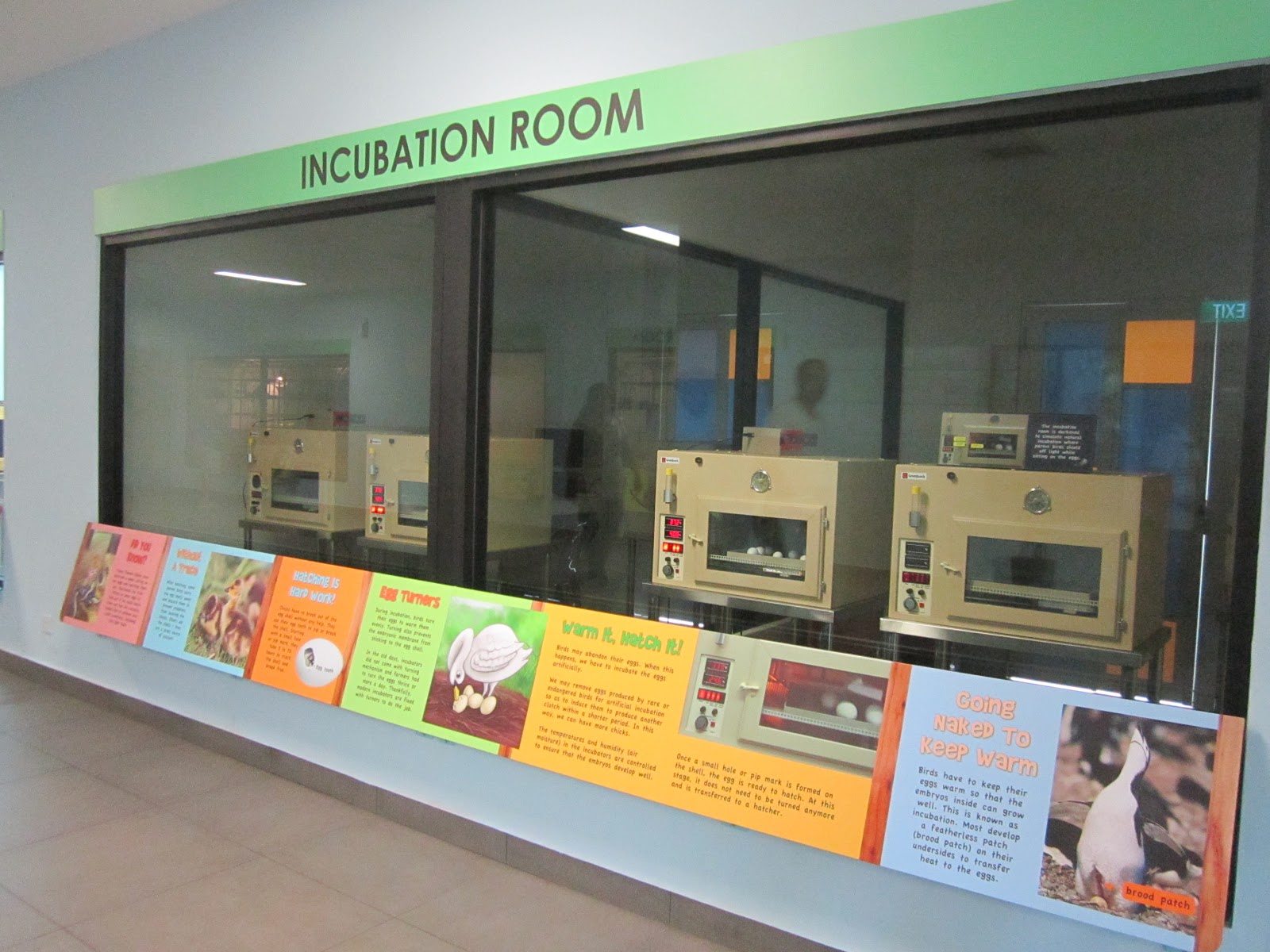
And the final station of the adventure was the Breeding and Research Centre. The reason I wanted to visit the park again was to have another look at this place! It brings to mind scenes from the Jurassic Park movie, where dinosaur hatchlings were incubated and fed.

The Incubation Room

 Eggs were taken care of with temperature and light controlled carefully

The Nursery for the hatchings

A newborn enjoying the attention of visitors or at least trying to make sense of it. The keepers have day/night shifts to ensure they are fed well and taken care of round the clock

 At the Weaning Room, they are taught to eat their staple solid foods. These were a rowdy bunch, making loud noises and demanding attention.

 Comparison of sizes (from the left): Elephant Bird, Ostrich, Chicken and Hummingbird eggs

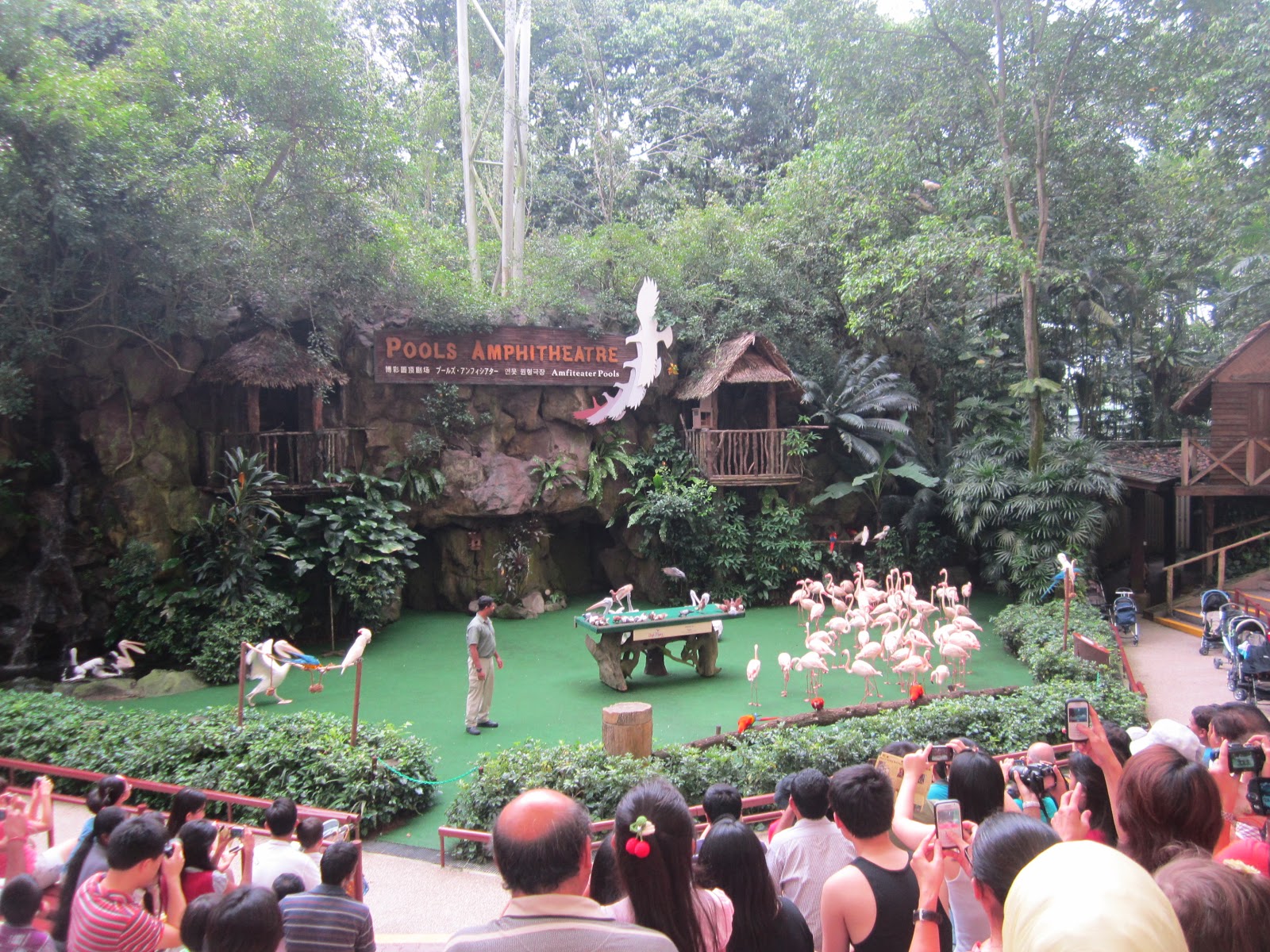
The adventure at the park ended with "High Flyers" - a show featuring over 100 birds. They were trained to entertain and showcase their strengths and abilities in flight and intelligence in learning to mimick sounds (even speaking human languages!), while also inspiring and making us humans more aware of why we have to reduce consumption and recycle the limited resources we have so that animals like these can continue to colour our planet and roam freely. What we can do to help really begins with a single mindful step of making the right choices that suit everyone. It's not that hard, really.

A very entertaining show, it was definitely a crowd pleaser

After the bird park, I set off to a lovely, cozy Christmas dinner at Katy Kat's place. The food and company were just perfect. Katy, If I had a time machine, I would go back in time and enjoy that restaurant-quality mushroom and cheese pie again, several times over!


Social Privilege

Not all of us are born to the same circumstances. There will always be differences in social status, which is determined by factors such as ...